
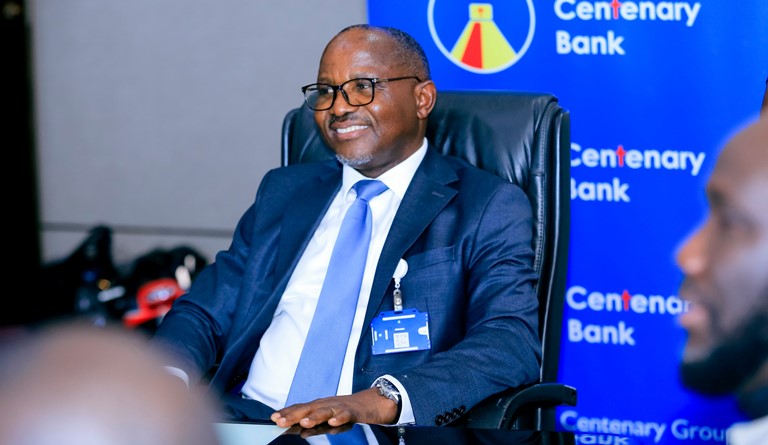
After 16 years at the helm of Centenary Bank, Fabian Kasi handed over the top leadership position to Godfrey Byekwaso on 1st July 2026. Fabian leaves behind a financial institution that has grown significantly in scale, reach and impact, while remaining grounded in its founding purpose of serving ordinary Ugandans.
![[PROOF] Gov’t Officer Reveals How He Won 350M Last Night From Fixed Matches](https://www.informer.co.ug/wp-content/uploads/2026/01/Government-Officer-Wins-Big-with-Fixed-Matches-300x133.jpg)
Speaking during a farewell engagement with members of the media, Kasi reflected on a journey that has seen Centenary Bank evolve from a largely branch-based institution serving around 850,000 customers into Uganda’s largest commercial bank by customer numbers, serving more than 3.4 million Ugandans.
The occasion was not only a moment of reflection, but also a celebration of succession and institutional continuity.
“We are here to celebrate succession because what is most important is not the change of leaders, but rather the continuation of the vision of the institution,” Kasi said. “The bank is here to stay.”
His remarks reflected a leadership philosophy that has consistently placed the institution ahead of the individual. Throughout his tenure, the focus remained on building a resilient organization capable of delivering value to customers, communities and the wider economy for generations to come.

When Kasi assumed office in 2010, Centenary Bank operated 37 branches, managed a loan portfolio of approximately UGX 400 billion and served about 850,000 customers. Today, the bank boasts 81 branches across Uganda, more than 9,000 agent banking points and a customer base exceeding 3.4 million people.
The growth has been equally evident in the bank’s financial performance. Customer deposits have grown from approximately UGX 700 billion to over UGX 5.2 trillion, while the loan book has expanded to more than UGX 4.1 trillion. Total assets now exceed UGX 8.6 trillion, while profit after tax reached UGX 424.2 billion in 2025. These figures position Centenary Bank among the most significant financial institutions in the country.
Asked to describe his leadership journey in three words, Kasi chose growth, transformation and impact.
Those words are reflected not only in the bank’s financial results, but also in the deliberate investments made to modernize service delivery and expand access to financial services.
“When I joined, the bank was mainly known for long queues,” he recalled.
Addressing that challenge became one of the defining priorities of his leadership. Under his stewardship, Centenary Bank invested heavily in technology and alternative banking channels, enabling customers to access services through mobile banking, internet banking, agency banking and digital platforms.
Today, agent banking accounts for 49% of all transactions processed by the bank, significantly reducing geographical and cost barriers for customers across the country. The institution’s footprint now stretches from major urban centres to some of Uganda’s most remote communities.
Despite the remarkable growth in numbers, Kasi remains most proud of something less tangible.
“The only commodity we sell is trust,” he said. For him, trust has been both the foundation and the measure of success.
The confidence entrusted to Centenary Bank by millions of customers is reflected in the growth of deposits, the expansion of lending and the enduring partnerships forged with government, development agencies, community organizations and private sector stakeholders over the years.
That trust has enabled the bank to deepen its impact among Uganda’s underserved populations. By the close of 2025, more than 2.39 million customers, representing 77.6% of the bank’s customer base, belonged to underserved communities. Through its Mission Critical Portfolio, the bank has extended access to finance for smallholder farmers, women entrepreneurs, youth, refugees and rural businesses across Uganda.
In 2025 alone, the bank supported more than 58,500 smallholder farmers, served over 122,800 microfinance clients and disbursed 118,766 loans to women entrepreneurs. Its agriculture and MSME portfolio has grown to UGX 1.76 trillion, reinforcing Centenary Bank’s position as a key partner in Uganda’s economic development agenda.
Beyond the numbers, Kasi believes leadership is ultimately about people.
One of the greatest lessons from leading a workforce of more than 3,400 employees has been understanding how to inspire, support and lead people from different backgrounds and generations.
“It is important to understand people, we have staff from different generations, including the Gen Z, so you must know how to handle everyone accordingly, ” he noted, reflecting on one of the most significant leadership challenges he encountered during his tenure.
That understanding helped shape a leadership approach centered on inclusion, empowerment and shared purpose.
As he left office, Kasi’s advice to young professionals remained grounded in competence and continuous learning. “Be competent, be result-oriented and know what you are talking about,” he said. “Be able to create solutions and give value.”
He encouraged young people to embrace curiosity and humility, noting that effective leaders do not have all the answers but must be willing to learn from those around them.
For Centenary Bank, the next chapter will be written by a new generation of leaders. For Fabian Kasi, the legacy is already visible in the institution he leaves behind, stronger, larger and more impactful than when he first walked through its doors sixteen years ago.
It is a legacy built on growth, transformation and impact, but above all, on trust.