Deputy Speaker of Parliament Thomas Tayebwa has called for a more inclusive partnership between the Organisation of African, Caribbean and Pacific States (OACPS) and the European Union (EU), with greater attention to young people and marginalized communities.
Tayebwa, who is President of the OACPS and Co-President of the OACPS-EU Joint Parliamentary Assembly, said the partnership should place young people and marginalised communities at the centre of development discussions and create opportunities for young people to address broader issues that will shape the future of their countries.

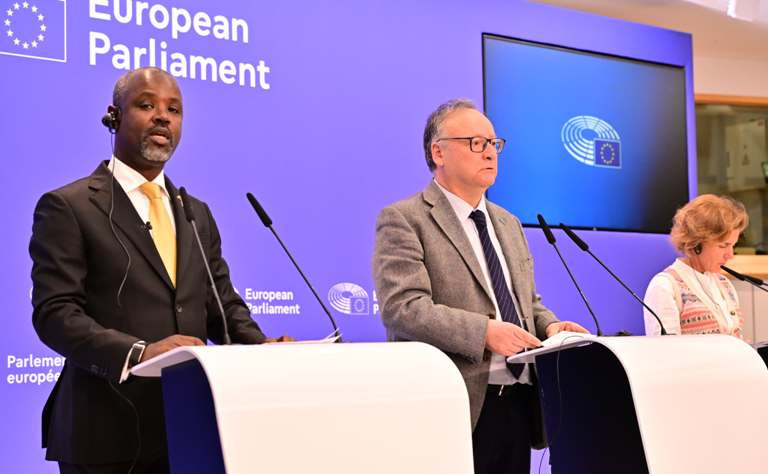
“If we are talking about climate adaptation, we are talking about young people. If we are talking about critical raw materials giving more value to the countries producing them, we are talking about young people because they are the ones going to get the jobs out of this,” he said at a press conference in Brussels this afternoon, alongside his EU counterpart, Francisco Assis.
He also cited ocean protection and climate resilience as areas with direct implications for future generations, stressing that young people should have a voice in decisions affecting their livelihoods.
His remarks come as OACPS and EU parliamentarians meet in Brussels from Monday to Friday to discuss the future of their partnership and the implementation of the Samoa Agreement.

Quick Implementation
Tayebwa called on governments and parliaments in both blocs to accelerate the outstanding ratification processes required to bring the agreement fully into force. Although the agreement is already being provisionally applied, he said completing the ratification process should be a shared political priority.
He urged parliamentarians to engage their respective governments, address outstanding concerns and build domestic support for the agreement.
Tayebwa also called for a partnership based on equality, mutual respect, shared responsibility and mutual benefit, emphasising that OACPS countries must have a meaningful voice in determining common priorities.
He highlighted critical raw materials as an important area of cooperation, arguing that resource-producing countries should move beyond exporting unprocessed resources to developing local industries, expanding processing capacity and creating skilled employment.
“Our people must share fairly in the wealth their resources generate,” he said.