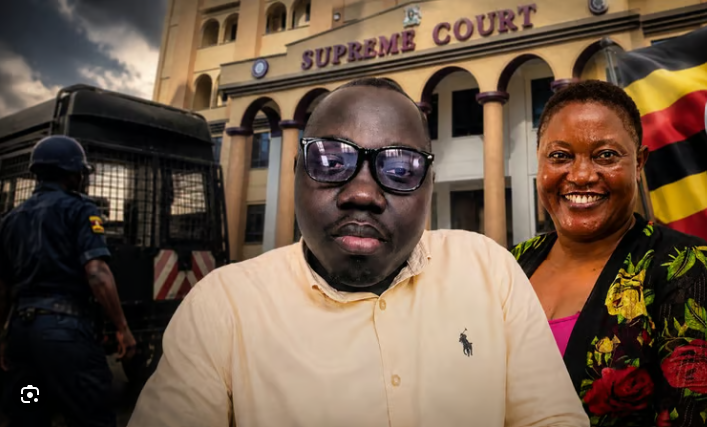
A Ugandan journalist has been held in detention for days—never once allowed to step into a courtroom—after authorities acted on what appears to be little more than his decision to post an article that was already circulating across much of East Africa.
Remmy Asiteza, who runs the blog dailyexpress.co.ug, was arrested in Kampala after publishing a piece about Milly Babalanda, the Minister for the Presidency. But the article, as far as outside observers can tell, was neither new nor original. It had been discussed and reposted in regional blogs and media outlets for weeks before Asiteza published his version. Still, it is he who is now behind bars.
Authorities have not laid any formal charges, and no court date has been announced. By accounts that have reached the outside world, Asiteza is being held in harsh conditions and pressured to abandon his sources—an approach that human rights and press-freedom advocates say mirrors tactics Uganda’s security services have used for years to intimidate journalists who get too close to people in power.
A “Crime” Everyone Had Already Seen
What is especially enraging in Asiteza’s case is how ordinary it appears. The report concerned the so-called A-RDC recruitment scandal: allegations that roughly UGX 15 billion disappeared during the hiring of Assistant Resident District and City Commissioners. The matter is serious enough that President Yoweri Museveni ordered the Internal Security Organisation to investigate and submit findings within two weeks.
![Jinja Policeman Reveals How He Won 280M From Fixed Matches [PROOF]](https://www.informer.co.ug/wp-content/uploads/2024/04/wins-millions-from-sports-betting-300x133.jpg)
The alleged figures are also difficult to ignore. Officers cleared for deployment in the 2022/2023 financial year were not actually posted until April 2024, and did not begin receiving salaries until July. During that time—between approval and payment—the funds earmarked for their wages and allowances did not return to the Consolidated Fund and did not reach the intended recipients. With 432 officers eventually deployed, sources now estimate the unexplained amount at more than UGX 24 billion. An internal audit claims the money was spent on office equipment, while other sources say assistant RDCs were instead sharing desks with secretaries—or, in some cases, operating with no proper office at all.
Yet none of this was hidden. Parliament had already raised concerns about the recruitment process before the controversy fully erupted, warning it could increase the wage bill by more than UGX 10 billion annually. The Auditor General’s office also has supporting documentation. Journalists across the region had already reported the broad outline of the issue. Asiteza did what many others did—he published it on his own platform—but in his case, he became the one targeted.
The Minister’s Silence, and the State’s Speed
The reporting that triggered Asiteza’s arrest was not the minister’s first entanglement in controversy. Babalanda has also been linked to allegations of a UGX 7 billion disappearance connected to the Uganda Printing and Publishing Corporation. Parliament’s COSASE committee has already called her to explain those claims.
Earlier reporting—first appearing on outlets such as NilePost—alleged that she influenced the removal of UPPC’s board in 2021, took control of procurement and management functions herself, and oversaw an account that sources say is now empty. The Auditor General later concluded that she was culpable for effectively stepping into board responsibilities during a period when oversight was not in place. Parliament has said it needs answers about her role as reflected in financial documents and a managing director’s appointment letter.
What stands out, however, is what did not happen. While allegations remain unanswered, the response from the state has instead fallen on the journalist who republished information already available in the public sphere.
For press freedom groups and civil society organizations, this imbalance—the lack of urgency toward the official facing major allegations, paired with swift action against the person writing about them—is the core concern.
A Larger Warning, Not a One-Off Case
Uganda’s Inspectorate of Government has estimated that corruption and procurement fraud cost the country between UGX 9 trillion and UGX 20 trillion every year, with some sectors accounting for close to 40% of the national budget. President Museveni has repeatedly described corruption as a major obstacle to development and has pledged consequences for those implicated.
Asiteza’s detention tests how far those pledges extend—particularly when the person at the center of the controversy holds a senior government position—and it also tests how much the state is willing to protect (or fail to protect) the journalists whose work is to expose wrongdoing.
Asiteza’s family, colleagues, and supporters are calling for his immediate release and for due process to be respected. Regional and international press freedom organizations are monitoring the situation closely, warning that allowing indefinite detention to stand—based on a story many already knew—sets a dangerous precedent that extends beyond one blog and beyond one minister.