
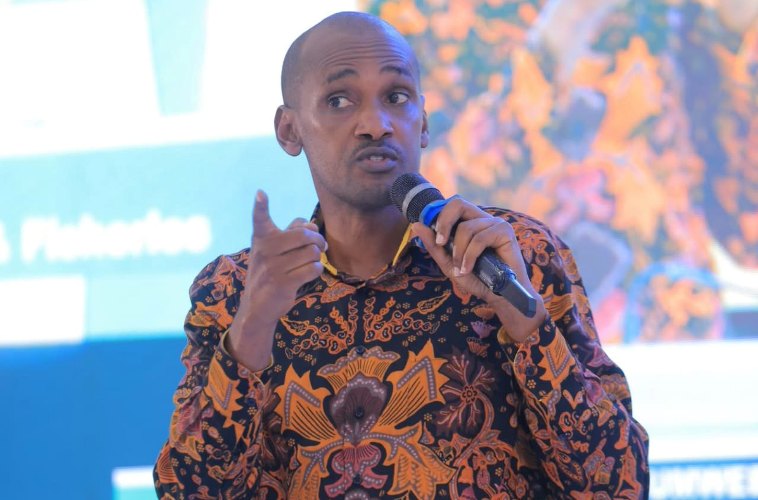
The Minister of Agriculture, Animal Industry and Fisheries, Hon Frank Tumwebaze, has called on district leaders to provide accurate, verified data to guide the design of Uganda’s proposed National Irrigation Development Project.
Tumwebaze made the remarks yesterday while speaking at the opening of a two-day engagement with district leaders at Imperial Royale Hotel, Kampala, where he said that the engagement is addressing four areas that include irrigation development, compulsory Foot and Mouth Disease vaccination, the regulatory framework for wild-capture fisheries and fisheries resources management and agricultural extension services.

He noted that less than 2% of Uganda’s agricultural land is under irrigation, compared to about 3.5–4% in Sub-Saharan Africa and 28% in Northern Africa, but because of increasingly erratic weather patterns, Uganda can no longer rely solely on rainfall to sustain agricultural production.
Minister Tumwebaze said the President has prioritised mass irrigation development to stabilise production and increase productivity.
He said that the proposed project will cover, on-farm water conveyance where reliable water sources already exist; irrigation systems near seasonal rivers and streams, profiling and rehabilitating non-functional irrigation schemes developed by Ministry of Agriculture Animal Industry and Fisheries and the Ministry of Water and Environment.

Others include bulk water systems for water-stressed communities, fish ponds, particularly in Bukedi, Busoga, Luwero and Kigezi and increased agricultural machinery and said that the Ministry is finalising a project concept for submission to the Ministry of Finance Planning and Economic Development and urged districts to provide verified information on existing facilities and last-mile water connectivity.
Minister Tumwebaze identified staffing, mobility and facilitation as critical to effective service delivery and challenged districts to account for vacant extension positions, available wage provisions, transport for extension workers and the use of Government-provided motorcycles and vehicles.
Hon Tumwebaze also questioned why farmers continue to report inadequate access to extension services despite improvements in staffing, mobility and facilitation and urged district leaders to strengthen supervision, ensure regular farm visits and use radio platforms to promote good agronomic practices.
He directed the Ministry’s extension department to update his previous circular on extension roles into a comprehensive extension services handbook and said leaders must confront service-delivery gaps and ensure that farmers see and benefit from Government services in their daily economic activities.