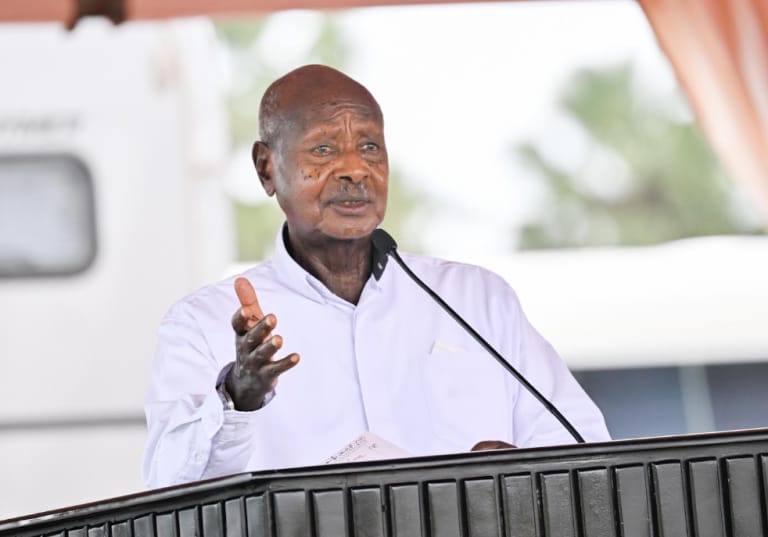
President Yoweri Kaguta Museveni has tasked medical professionals to develop a cost-effective healthcare strategy that prioritises disease prevention, saying about 80% of illnesses in Uganda are preventable and should not require expensive treatment.
President Museveni cited immunization as one of the most effective preventive interventions, pointing to Uganda’s progress in eliminating measles and polio mentioning the expansion of the national immunization programme, which initially targeted six killer diseases responsible for about 96,000 child deaths annually, but demonstrated the impact of preventive healthcare.

President Museveni said the country must shift greater attention towards preventive healthcare through immunisation, proper nutrition, hygiene, safe water, sanitation and public education, rather than concentrating largely on treating diseases after they occur.
The President made the remarks November 13th 2026, while speaking at the 10th Uganda Medical Association (UMA) Grande Doctors’ Conference at Soroti University, where he challenged doctors to look beyond treating diseases and take a leading role in promoting healthy communities, and the conference was held under the theme: “Harnessing the Numbers and Quality for Socioeconomic Transformation and Global Health.”
President Museveni identified poor hygiene, inadequate nutrition, early marriages, alcoholism and unsafe food handling as major contributors to preventable illnesses and warned against the consumption of mould-contaminated groundnuts that expose people to cancers.

The President revealed that he has committed Ugx 125 billion as seed capital for a Doctors’ Savings and Credit Cooperative Organisation (SACCO), aimed at improving medical professionals’ welfare, financing further education, reducing moonlighting and also confirmed a tax waiver on Doctors’ salaries.
The President challenged Doctors to abandon what he described as moonlighting, where medical professionals divide their time between government hospitals and private health facilities, warning that the practice must come to an end.
He attributed the emergence of moonlighting to the collapse of public health systems, recalling that before 1970, most African doctors worked exclusively in government hospitals because they earned adequate salaries and faced less financial pressure to seek additional employment.
He also announced that government will remove taxes on doctors and other medical personnel, extending to them the same tax exemption enjoyed by security personnel, including soldiers, Police officers and Prison officers.
President Museveni endorsed the Doctors’ proposal to hold annual meetings and pledged government support towards establishing doctors’ shops similar to army shops.
He however advised that they should prioritise essential commodities such as building materials rather than alcohol and perfumes adding that government will work towards addressing the financial pressures driving doctors into multiple jobs, with the aim of restoring their commitment and stability in public health facilities.
The President called for targeted specialisation and increased investment in training medical specialists, directing the training of at least 200 geriatric doctors at government expense to address critical gaps in that particular aspect.
President Museveni noted that medical training must respond to the country’s specific healthcare needs by identifying areas with acute shortages and deliberately developing the required expertise.
He cited geriatrics, a medical specialty focusing on the health of elderly people, revealing that Uganda has only three to four specialists in the field and upon his previous interactions with doctors prompted his order to avail government-funded scholarships for at least 200 specialists.
He also raised concern over the shortage of paediatric cardiologists, revealing that Uganda has only about 12 specialists to manage congenital heart conditions in children, which require early diagnosis and urgent intervention to prevent deaths.
He therefore challenged medical training institutions to identify other critical areas requiring specialisation, assuring them of government’s willingness to finance the training of specialists.
President Museveni commended the Soroti University for following his earlier advice to focus on sciences, dismissing programmes such as women’s studies, sociology and conflict resolution as areas that should not take priority over science education saying universities must align their training programmes with the country’s development needs.
The President has also directed his staff to obtain a copy of the University Vice Chancellor’s presentation and the President of the Uganda Medical Association, promising to study their recommendations and engage relevant government sectors to address the issues raised.
He warned institutions and individuals commercialising medical education against offering substandard training, saying the practice must be stopped to protect the quality of Uganda’s healthcare workforce and criticised what he described as poor-quality medical training and the growing tendency to turn medical education into a business, insisting that those responsible must be held accountable.
President Museveni tasked district health officers with conducting regular radio programmes in local languages to educate communities on disease prevention.
He proposed that medical officers dedicate at least one broadcast every two weeks to advising the public on healthy practices, citing previous public education campaigns against HIV/AIDS and tuberculosis among other past effective health mobilisation strategies that yielded great health results
He also pointed to Uganda’s experience in controlling tuberculosis, Guinea worm and bilharzia through improved housing, safe drinking water, sanitation and community awareness, urging the medical association to make preventive healthcare a central pillar of its conference declaration.
While speaking at the same event, the Vice President Major Jessica Alupo Epel credited President Museveni’s political commitment and leadership for the progress made in Uganda’s health sector, saying improved public health is critical to job creation, wealth generation and national productivity.
She noted that a healthy population is better positioned to exploit its potential and contribute to socioeconomic transformation and applauded Presedent Museveni for championing public health, particularly in the prevention and management of epidemics, adding that Ugandans have been the primary beneficiaries of his commitment to strengthening the health sector.
Major Alupo highlighted preventive healthcare, citing the expansion of Uganda’s immunisation programme from six vaccines targeting diseases that killed about 96-thousand children annually to the current 13 vaccine and called for greater public awareness on hygiene, proper nutrition, early marriage, alcoholism among other vices
Uganda Medical Association proposed Strategic Compact for Health Sector Reforms aimed at strengthening Uganda’s healthcare system and accelerating national health transformation.
While presenting the proposal, the Uganda Medical Association’s President, Dr Frank Asiimwe, said that the compact is intended to provide a framework for strategic collaboration between government and medical professionals, drawing on their collective expertise, experience and accountability to address challenges in the health sector.
Dr Asiimwe revealed that the Association, brings together close to 15,000 doctors across 14 branches and is committed to strengthening professional discipline, accountability and mentorship while working with government to unlock the full potential of Uganda’s health workforce.
Dr Asiimwe acknowledged government’s investments and achievements in public health, but noted that persistent systemic barriers require joint intervention to accelerate progress and the medical fraternity was presenting five targeted priorities to guide reforms and improve the country’s healthcare delivery and traced the proposal to the strategic dialogue initiated during the first Grand Doctors Conference in 2016, which President Yoweri Museveni attended as chief guest.
Dr Asiimwe announced that the Association’s National Executive Council had conferred upon him its highest institutional distinction, honorary membership number UMAHM00001 to President Yoweri Kaguta Museveni and hailed the country’s significant progress in the health sector, citing increased life expectancy, reduced maternal mortality, improved health financing and strengthened capacity to manage disease outbreaks.
Dr Asiimwe said that Uganda’s life expectancy has risen to 68 years, while growth in domestic pharmaceutical manufacturing and improved health financing have strengthened the country’s capacity to respond to public health emergencies, including epidemics such as Ebola and cholera.
He highlighted kidney transplantation at Mulago National Referral Hospital as one of the major milestones towards clinical self-reliance, enabling Ugandans to access complex medical procedures locally.
He further applauded President Museveni for his leadership and contribution to the progress made in the health sector, while commending Ugandan doctors for delivering specialised medical services under difficult working conditions, training successive generations of medical professionals and safeguarding the country against disease outbreaks.
However, he noted that despite the achievements, several systemic challenges remain and require urgent attention to accelerate improvements in healthcare delivery.
Prof Francis Omaswa, a distinguished medical scholar and founding Chairperson of the Uganda Medical Association, called for increased investment in primary healthcare and community-based health services to accelerate improvements in Uganda’s health indicators, saying that although Uganda has registered significant progress in life expectancy, maternal and child health, more effort is needed to achieve international health targets.
Prof Omaswa urged political leaders at all levels to make health a priority and mobilise communities to demand and participate in healthcare services and cited Uganda’s response to COVID-19, particularly the activation of village COVID-19 task forces, as an example of how community engagement can strengthen public health interventions.
He called for stronger collaboration between ministries with health considerations integrated into sectors such as water, education and housing rather than treated as the responsibility of the Ministry of Health alone and called for stricter regulation of medical training institutions, warning that failure to enforce professional standards could undermine Uganda’s health service delivery.
Prof Omaswa said that institutions that fail to comply with guidelines set by the Medical and Dental Practitioners Council and the National Council for Higher Education should be closed to prevent the training of inadequately prepared health professionals.
He warns that without urgent intervention, Uganda risks producing a generation of health workers whose professional attitudes and standards could compromise the quality of healthcare.
He also challenged doctors to make professionalism, accountability and ethical conduct the foundation of their practice, urging them to hold one another responsible for delivering quality services and further welcomed a proposal for the President to meet doctors twice a year, saying the engagements would provide an opportunity to monitor their commitments, assess progress and address challenges affecting the medical profession.
Soroti University Vice Chancellor Prof Ikoja-Odongo commended government for its investment in the institution, saying funding provided has enabled the completion of an academic block that is now operational, easing the shortage of teaching space and has improved the university’s capacity but appeals for more lecture blocks and laboratory facilities to accommodate growing student numbers.
Prof Ikoja-Odongo credited the government of Uganda for facilitating the proposed teaching and Regional Referral Hospital adding that the University has allocated 50 acres for the project, with encroachers removed and an irregular land title cancelled, clearing the way for construction of the Ministry of Health-managed facility.
He further applauded government for establishing the Centre for Nuclear Science and Technology at Soroti University, saying it will strengthen Uganda’s nuclear energy programme through specialised training and research to produce radioisotopes for cancer treatment, reducing dependence on foreign countries for essential medical technologies and services.