From Uganda’s fiercest opposition stronghold to a single-party stronghold for the NRM, Rukungiri’s next test is not at the ballot box. It is whether united leaders can finally deliver on the leadership promise.Rukungiri has never been an ordinary political district. It produced men and women who stood at the center of Uganda’s defining political battles. It produced fighters in the liberation struggle, and later some of the country’s most prominent opposition voices in Uganda’s history. For decades it was one of Uganda’s strongest opposition strongholds, an identity built largely around Col. (Rtd.) Dr Kizza Besigye, who contested the presidency several times and, in 2016, defeated President Yoweri Museveni on his home turf of Rukungiri.

Then politics changed. The 2021 elections gave the NRM three of Rukungiri’s four parliamentary seats, leaving the opposition just one. By the 2026 elections the shift was complete: the NRM swept all four parliamentary seats, took the district chairperson’s office, and won the Rukungiri Municipality mayoralty as well. Thus, Rukungiri has moved from opposition heartland to NRM hub. That should not simply change the color of the district’s political rallies.It should change the quality of its leadership.
The question in no longer who won.
Rukungiri’s voters have already spoken. The harder question is what their leaders now do with the power they were handed.When nearly every seat of political authority in parliament, the district and the municipality belongs to the same establishment, there is a rare opening for coordinated lobbying and fast development. Save that we still have fights among them. Leaders disagreeing is not unusual because different personalities, histories and ambitions all guarantee it. What is dangerous is when those disagreements start to matter more than the problems facing ordinary citizens. Reports over the past year have pointed to real friction inside Rukungiri’s NRM leadership. For example, there was a failed reconciliation attempts in 2025, and youth leaders publicly demanding intervention over the divisions. None of this proves every claim traded between leaders is true; political accusations deserve evidence and a fair hearing. But it raises a fair question. “When leaders are fighting each other, who is fighting for the ordinary citizen?”
Rukungiri cannot afford leaders stuck in history.
Some of Rukungiri’s political rivalries run deep, shaped by old contests, broken alliances and personal grievances built up over years. History should be understood, not worshipped. A leader who spends the present refighting yesterday’s battles risks losing tomorrow’s opportunities.Rukungiri’s young people are not asking which leader disliked which leader a decade ago. They want jobs. Farmers want markets. Parents want better schools. Patients want functioning clinics. Business owners want reliable roads and power, and a predictable place to invest. Young professionals want a reason to build their careers at home instead of in Kampala.
These are the questions that should dominate the public conversation, not old scores. For example, picture Rukungiri walking into a national conversation with a single, coordinated program covering and demanding, stronger health services, agricultural value addition, youth employment and enterprise, tourism development, education and skills training, water and sanitation, support for local businesses, digital connectivity and investment attraction.That is the kind of politics that produces results. The alternative, endless competition over who holds more influence than whom, might generate headlines. It will not build a single road.
Leadership must never become humiliation.
There is a harder conversation Rukungiri needs to have. A video recently circulated showing a political leader at a local event throwing pieces of cake toward a crowd, drawing public criticism once the incident was reported. The point here is not to convict anyone on the strength of one clip, or to guess at intent. The real question is bigger. How do leaders treat the people they serve?
Public office should come with dignity, on both sides. The people standing before a leader are not a crowd to be managed; they are citizens, voters and taxpayers, parents, farmers, teachers, health workers, traders and students. They deserve respect. Moral leadership is bold and sacrificial, not soft. It puts the interests of the people ahead of personal pride. It listens when people disagree. It apologizes when it must. It never turns public platforms and public resources into instruments of humiliation, and it never forgets that leadership is temporary while the community it serves is not.
We need to know the difference between a leader and a manipulator and we are good to go.
This may be the most important distinction Rukungiri needs to make. A leader helps people understand their problems and organize to solve them, while a manipulator manufactures enemies so people stay emotionally dependent on him. A leader builds institutions while a manipulator builds personal loyalty. A leader creates opportunity; a manipulator creates dependence. A leader can disagree with you without treating you as an enemy but a manipulator makes disagreement feel like betrayal.
Rukungiri’s political maturity has to move past personalities and start judging leaders by what they deliver, how they treat people, and how responsibly they use the influence they hold. That is a far healthier question than “who does not like whom.” The better question is: how do we lead Rukungiri into prosperity?
A new story for an old political district Rukungiri’s history should make its people proud, and thoughtful. This is a district that produced people who went to the bush when they believed Uganda needed change, who stood firm in opposition when they believed government needed challenging, and who later joined the ruling movement as circumstances shifted. That history says one thing clearly, that Rukungiri’s people are not politically passive. They think, they debate, they organize, they challenge authority. That energy now needs to be redirected toward development. The district’s greatest political achievement should not be proving that one faction beat another.
My Personal View
Rukungiri does not need leaders who agree on everything. It needs leaders who can disagree without abandoning the people. we need moral leaders irrespective of their political history or intentions.
Rukungiri has a proud political history. History alone will not build its future. That will take leaders willing to set differences aside, work together, and turn political influence into tangible prosperity.The people are watching.The people are listening.And more than anything, they deserve better than political rivalry. They deserve results.
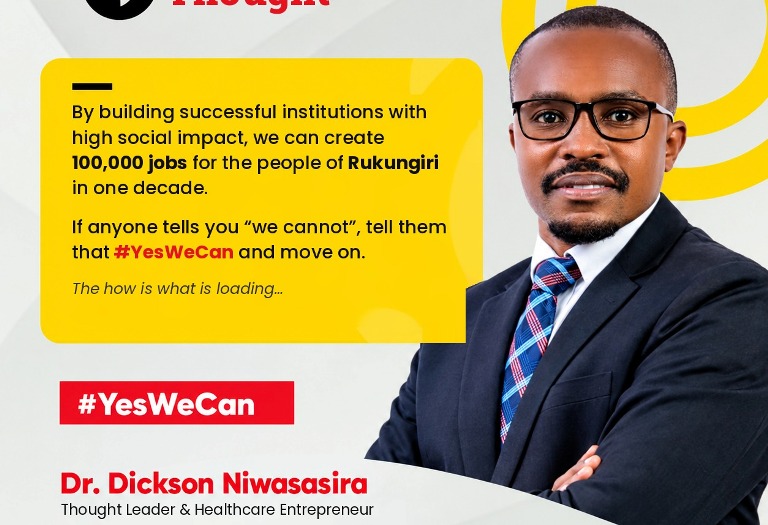
Dr. Dickson Niwasasira
Resident of Rukungiri, a medical doctor, social entrepreneur and a Development Enthusiast