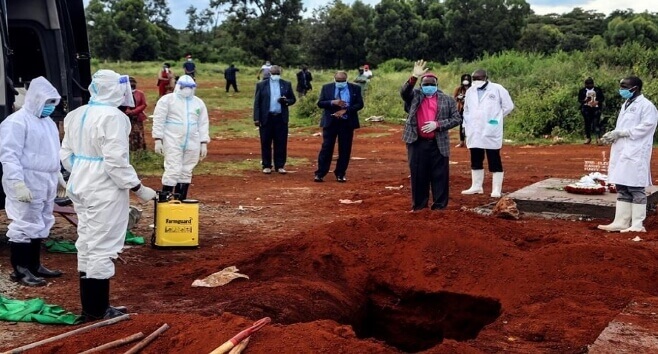
The World Health Organization has said that the number of suspected Ebola cases in Democratic Republic of the Congo has risen to 600, with 139 suspected deaths.
The World Health Organization Emergency Committee met in Geneva yesterday where Director-General Dr Tedros Adhanom Ghebreyesus confirmed to reporters that the virus remains a public health emergency of international concern, but not a pandemic emergency.
![[PROOF] Gov’t Officer Reveals How He Won 350M Last Night From Fixed Matches](https://www.informer.co.ug/wp-content/uploads/2026/01/Government-Officer-Wins-Big-with-Fixed-Matches-300x133.jpg)
Dr Tedros explained that the World Health Organization has assessed the risk of the epidemic as high at the national and regional levels and low at the global level.
Previous figures reported by Democratic Republic of Congo officials were an estimated 131 deaths from 513 suspected cases and the outbreak has arisen just five months after the country declared its previous epidemic over.
World Health Organization Emergencies Chief Chikwe Ihekweazu said at the same news conference that the organisation’s absolute priority now is to identify all the existing chains of transmission to enable them define the scale of the outbreak and be able to provide care.
![It Works! How Single Mom Makes 3 Millions Weekly From Sports Betting [PROOF]](https://www.informer.co.ug/wp-content/uploads/2024/04/Single-mum-300x204.webp)
Dr Tedros first declared the emergency on Sunday and said he had done so without consulting other experts due to the urgency of the situation, but health authorities have since said that the outbreak is being fuelled by the Bundibugyo strain, a type of Ebola virus which no vaccine or treatment.
The World Health Organization said that the 600 suspected cases, 51 had been confirmed in the Democratic Republic of Congo Northern Provinces of Ituri and North Kivu and Uganda has also confirmed two cases in Kampala, including one death, from two people who travelled from the Eastern Congo to Uganda.
It is reported that medical missionary who contracted Ebola in the Democratic Republic of Congo is also being transported back to Germany for treatment and World Health Organization experts said that they believe the outbreak began a few months ago, with the first suspected death reported on April 20th 2026.
After the first death, health officials said, a suspected super-spreader event is believed to have taken place at either a funeral or a healthcare facility, though investigations are ongoing.
Meanwhile the European Union spokesperson Eva Hrncirova has said that the risk of an outbreak in Europe is very low because there is no indication that Europeans need to do anything other than follow standard health advice.
Meanwhile the Democratic Republic of the Congo football team have cancelled a three-day World Cup preparation training camp and a planned public farewell to fans in the capital, Kinshasa, because of an Ebola outbreak in the Eastern parts of the country.
The Democratic Republic of Congo Foofball Team are scheduled to play World Cup warm-up games against Denmark in Liege, Belgium, on June 3rd and Chile in southern Spain on June 9th and both matches are going ahead as planned.
The team spokesman Jerry Kalemo told journalists yesterday that there were three stages of preparation, which included the one in Kinshasa to say goodbye to the public, Belgium and Spain with two friendly matches against Denmark in Liege and Chile in Spain, and the third stage from June 11th in Houston, United States, but only one stage in Kinshasa was canceled.
The team’s pre-tournament preparations will now take place elsewhere after an outbreak of a rare type of Ebola known as Bundibugyo, which is thought to have killed more than 130 people and caused nearly 600 suspected cases.
The World Health Organization has declared it a public health emergency of international concern, but all of the Democratic Republic of Congo players and the team’s French coach, Sebastien Desabre, are based outside of the central African country, with most of them playing in France and a number of team staff who are based in the country have also left.
Football’s governing body FIFA issued a statement that it is aware of and monitoring the situation regarding an Ebola outbreak and is in close communication with the Democratic Republic of Congo Football Association to ensure that the team are made aware of all medical and security guidance.
The American Centers for Disease Control and Prevention said this week that the US would ban the entry of all foreign nationals who had been in Democratic Republic of Congo, Uganda and South Sudan within the past three weeks and the ban lasts for 30 days, but the Congolese World Cup team would not be affected by the CDC entry ban because they had been training in Europe for the past several weeks.
That means team members, coaches and other officials who have not returned to Democratic Republic of Congo in the past three weeks would not be subject to the entry ban, according to the official who spoke on condition of anonymity because the policy has not been publicly announced.
Those members of the Congolese World Cup delegation who did return to Democratic Republic of Congo during the 21 days will be subject to the same quarantine requirements as US citizens seeking to return from affected countries and that exception will not apply to Congolese fans who want to attend the World Cup.
The White House World Cup Task Force, housed under the Department of Homeland Security, stressed that it is coordinating closely with various agencies on health and security matters and that the government is closely monitoring the Ebola outbreak in Africa.
Additional Reporting from Associated Press.