
President Yoweri Kaguta Museveni has instructed National Resistance Movement (NRM) Members of Parliament to return to grassroots approaches to leadership. He urged them to frequently engage citizens, closely monitor government programmes, and directly address challenges affecting local communities.
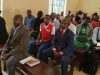
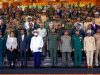
Speaking on Friday, October 2, 2026, during an address to the NRM Parliamentary Caucus at the Kololo Independence Grounds in Kampala, President Museveni—who also serves as NRM National Chairperson—made the remarks as NRM MPs resumed work following a three-week parliamentary recess.
The meeting was the fourth gathering of the first session of the 12th Parliament.
President Museveni also warned lawmakers against corruption, urging them to adopt the anti-corruption approach championed by the Minister for Local Government, Hon. Balaam Barugahara.
He said Hon. Balaam’s method is practical and affordable, describing it as one of the earlier strategies that helped the NRM build support among citizens.
“Some people miscalculated, but slowly we have taken up the role of fighting corruption in the army, and now we are beginning to wake up. Hon. Balaam is implementing what I have been talking about all the time,” President Museveni said.
![[PROOF] Gov’t Officer Reveals How He Won 350M Last Night From Fixed Matches](https://www.informer.co.ug/wp-content/uploads/2026/01/Government-Officer-Wins-Big-with-Fixed-Matches-300x133.jpg)
He explained that the NRM earned the trust of the public because its leaders were actively involved in solving problems at community level.
“What Balaam and Nameere are doing is fighting corrupt people. That is why I brought them into local government. We fought corruption in the army, and now the vice has been in the villages,” he added.
The President urged MPs to hold barazas and other forms of community engagement within their constituencies, rather than relying on highly organised events that he said can create a gap between leaders and citizens.
“I appeal to you to interact with the people directly. When you do that, you will find it easier to solve people’s problems. This practice of bringing food, water and musicians is happening because you have detached from the people. Instead, focus on the issues—so please return to the NRM work methods,” he said.
MPs Tasked to Monitor the Parish Development Model (PDM)
On wealth creation, President Museveni tasked MPs with closely monitoring the Parish Development Model (PDM) in their constituencies to ensure that intended beneficiaries receive funds meant to help them move into the money economy.
Regarding PDM, he instructed MPs to verify which families have received PDM support and which have not, so the remaining percentage of people outside the money economy can be reached.
He urged MPs to ensure the Shs1 million PDM revolving fund reaches the intended beneficiaries, and to spend more time in their constituencies assessing the programme’s impact.
“This is your work as MPs—inspect it. Spend more time in your constituency and check how your people are getting out of poverty,” he said.
Security Concerns: Killings and Theft Investigated
Addressing insecurity in Greater Ankole and neighbouring regions, President Museveni directed the Ministry of Internal Affairs and security agencies to investigate and respond to reports of killings and theft.
He cited concerns such as reports of more than 15 people killed in Ibanda, cattle theft in Kyankwanzi, and theft in Kagadi.
“The police are supposed to be in the sub-county. I will look into the issues of theft and killings in villages being reported. It is a concern. I have been watching crimes on TV,” he said.
He indicated he would engage police leadership to address gaps in policing and overall security.
Agriculture: Irrigation Now a Priority
On agriculture, President Museveni said irrigation should no longer be treated as optional, arguing that it stabilises production and increases yields.
“Irrigation is now a must. It stabilizes agriculture and increases yields. You can hear in our farm which we run with Dr. Muranga—we are yielding 53 tonnes per hectare,” he said.
He also reiterated that wetlands must be protected and encroachers removed.
“All those people in the wetlands must get out. The ones in Busoga, Bukedi and Kigezi—I have a programme to take them back to fish farming. All the others must get out. Wetlands will give us water for irrigation and also a source of income,” he said.
Energy, Transport, and Oil Value Addition
President Museveni said Uganda has a small electricity surplus but must continue developing new generation capacity, including the Ayago hydropower project.
“We have a little surplus of electricity, and that is why we have to move to Ayago. For electricity we must move,” he stated.
He added that government was considering railway development to Karamoja and extending the Standard Gauge Railway to northern Uganda to improve transport connectivity and access to external markets.
On oil, President Museveni said Uganda will continue pursuing value addition, including building a petroleum refinery in Hoima.
“Everything we produce must be processed,” he said, citing the Dangote refinery in Lagos as an example of how petroleum produced in one part of a country can be processed domestically to benefit the wider economy.
He reiterated that Uganda’s decision to prioritise refinery development before large-scale crude oil production was deliberate.
“The moment we discovered oil, people were saying we should export crude. I told them very clearly: no refinery, no production. It has been there for decades—let it stay there,” he said.
He explained Uganda accepted the crude oil export pipeline through Tanzania while maintaining that the refinery remains central to Uganda’s oil development strategy, using his shirt as an illustration of vertical integration and domestic value addition.
He said the shirt was grown, processed, and manufactured in Uganda, reflecting the NRM’s position that value must be added at multiple levels locally.
He added that cotton can be processed through stages such as spinning, weaving, printing and tailoring, before becoming a finished product—creating employment and increasing earnings.
He also cited the dairy sector as an example of “horizontal integration,” noting production of yoghurt, butter and other dairy products.
Economy and Employment Focus
President Museveni said Uganda’s economy continues moving forward despite global conflicts, attributing this to the NRM’s long-term economic programme.
He noted that key sectors for creating wealth and employment include commercial agriculture, manufacturing, services, and ICT.
Chief Whip Reports Election Petitions and Legislative Progress
Earlier, Dr. Jane Ruth Aceng—the Government Chief Whip and Chairperson of the NRM Parliamentary Caucus—thanked President Museveni for convening the meeting as MPs returned from recess.
She also conveyed condolences to the Kingdom of Tooro and the royal family following the death of King Oyo Nyimba Kabamba Iguru Rukidi IV, and congratulated the new king, Edward Kijanangoma Nyabongo I.
Dr. Aceng informed President Museveni that NRM MPs and flag bearers were facing election petitions connected to the 2026 general elections, noting that a total of 75 petitions are involved and that legal representatives are seeking support for legal facilitation.
On legislative business, she reported progress on the Agriculture Regulatory Bill, 2026, and a committee report on the Kampala Expressway and toll collection.
She said the report recommended criminal investigations by relevant institutions including the Inspectorate of Government, Directorate of Public Prosecutions, Criminal Investigations Directorate and the Uganda Revenue Authority.
Constituency Concerns Raised by MPs
Other MPs used the meeting to raise issues affecting their constituencies.
Hon. Laura Kanushu, MP representing Persons with Disabilities (PWDs), raised concerns about alleged diversion of PDM funds meant for PWDs to non-PWD beneficiaries.
In response, President Museveni warned against misuse of funds intended for PWDs, stressing that money should reach the intended beneficiaries.
He also said government would continue supporting tea production and value addition, describing tea as a large-scale project contained in the NRM manifesto.
On garbage management, he stated government would develop proposals to improve waste collection and management, noting that garbage can be turned into wealth.
NRM Caucus Adopts Nine Resolutions
The NRM Parliamentary Caucus adopted nine resolutions covering corruption, government programmes, security, wealth creation, water, energy, infrastructure and regional integration.
The resolutions reaffirmed continued coordination between MPs and the caucus to implement government business in Parliament, guided by President Museveni.
On corruption, the caucus committed to intensifying the fight against the vice by returning to the original NRM work methods, including engaging citizens on the ground and strengthening supervision of government programmes at local government level, including in health and education.
They also resolved to increase vigilance against crime, especially livestock and coffee theft and murders, and to report cases to relevant authorities.
On economic empowerment, the caucus resolved to strengthen monitoring of government development programmes—especially PDM—to support the inclusion of the 33% of Ugandans who remain outside the money economy, and ensure PDM funds earmarked for persons with disabilities are strictly disbursed to the intended beneficiaries.
On water, energy and infrastructure, the resolutions prioritised increased water availability for both domestic use and large-scale irrigation to stabilise agricultural production, increase yields and protect the environment.
For energy, MPs resolved to support additional hydropower projects, including Ayago and Kiba, and the introduction of solar and nuclear energy to complement existing power sources.
They also resolved to support expansion of the railway network and development of the oil refinery to accelerate economic development.
Finally, the ninth resolution committed the caucus to supporting the political and economic integration of East Africa and Africa toward a common market.