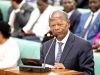

President Museveni has written a letter to those shepherding the sovereignty bill mainly to Hamuson Obua the chief whip of the NRM party and to the Attorney General Kiwanuka Kilyowa to reconsider the contents of the proposed bill which the president considers offensive to his initial guidance. We say shepherding because the etymology root of the word sovereignty is theology—i.e. the sovereignty of God. The two excited assistant political pastors have been behaving like the proverbial good runner who was praised to be a supper runner and run past his home and so got lost. Those who drafted the bill misrepresented H.E the president’s intentions and this gave the wrong impression and obscured the real intention of the sovereignty bill which was to protect and safeguard the policy making space from unnecessary foreign influence.
![[PROOF] Gov’t Officer Reveals How He Won 350M Last Night From Fixed Matches](https://www.informer.co.ug/wp-content/uploads/2026/01/Government-Officer-Wins-Big-with-Fixed-Matches-300x133.jpg)
Uganda is still an indebted country, receives much aid especially social services aid, and is a net receiver of foreign direct investments (FDIs). These structural constraints cannot allow the country enjoy sovereignty as envisaged in the bill as drafted by the movers and tabled in parliament. Unlike the president who understands the global context dynamics, the drafters of the bill were ignorant of the global and national contexts.
Firstly, Uganda has a liberalized capital account regime framework arrangement where foreign investors bring here capital and can take away more than one hundred percent. I say more than one hundred percent because some investors bring here say one million dollars, buy some privatized assets that they find here, mortgage these to the banks and get money and repatriate it back to their home countries. Some investors come here, get free land and mortgage the land, get the loan which they use. Most investors are actually wealth speculators rather than wealth creators! This way these investors actually take away more than what they bring to the country. It is actually through these investors that Uganda’s economic sovereignty is most compromised. President Nkrumah best captures this sovereignty through economic independence when he said that political independence is meaningless without economic independence.

Secondary, as the common observation teaches us here in Uganda, once food has been undercooked (kukona) even if you put it back on fire it cannot overcome the state of being undercooked. The original bill as tabled has mobilized bias against any new version the government may bring in the new form. It rubbed citizens in diaspora the wrong way when they were defined as non citizens by virtue of being outside the country. It equally rubbed development partners up the wrong way who were assumed in the bill to be hostile foreigners. For example, if a Ugandan is granted audience by a foreign development partner entity such as EU, UK, US Congress, WTO, ILO or UN and this Ugandan evaluates government policy negatively; the said Ugandan would be charged and convicted. The implication of this conviction is that the foreign development partner becomes an accomplice and therefore an enemy of Uganda through this conviction.
Thirdly, the sovereignty bill as drafted criminalizes and silences intellectual debates. Any Ugandan intellectual whether academic, researcher, consultant or activist who is in one way or the other associated with a foreign development or research partner and dares to evaluate a government policy negatively commits a crime. Government policies are not sacrosanct. The essence of democracy is about allowing room for policy evaluation and policy can be evaluated negatively, positively or both. Criminalizing evaluating government policy negatively tantamount to shutting down democracy.
The bill as drafted is also against the spirit and letter of sustainable development goals (SDGs) to which Uganda is a signatory. Goal 17 of SDGs talks about global partnership for development. In a legal regime where policy evaluation is criminalized, there cannot be partnership for development. The bill as proposed indirectly defines development partners as foreign hostile agents. This is because any citizen of Uganda whether intellectual or politician who evaluates government policy negatively and is associated with any development partner such as the EU or UK parliament commits an offence and is liable to 20 years in prison! A court process that involves convicting a citizen that has evaluated a public policy negatively, and, that citizen happens to be associated with a development partner will raise eye blows and will create tension between the government of Uganda and the development partner. This bill has the potential of creating diplomatic crisis for Uganda.
Finally, the bill as drafted seems to be targeting private citizens who are in civil society or in opposition. However the existential threat to Uganda’s policy sovereignty space is actually state agents and not private citizens seeking to participate in their country’s governance space, which space is given to them under article 38 of the 1995 constitution which guarantees civic rights and activities. It explicitly entitles every Ugandan citizen to participate in the affairs of government either directly or through representatives—and to engage in peaceful activities to influence government policies through civic organizations. Cabinet ministers and ambassadors normally go abroad and sign away our future through various multilateral and bilateral investment, trade, health etc agreements. The latest to be signed this year is the health cooperation agreement where we will send all our health data to US without any limitations or restrictions.
A bill is as political as it is legal. The drafters of bills whether in the Parliamentary council or Attorney General’s chambers must always put into consideration the global and national context while drafting bills otherwise their legalese is bound to conflict with the president’s intentions.
By Magufuri Moses Mugisha Rtd Lt 0701749879